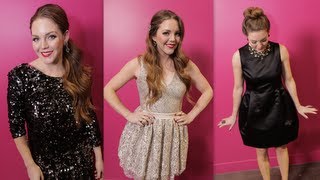
Why we wear this
 Fashion is something we deal with everyday. Even people who say they don't care what they wear choose clothes every morning that say a lot about them and how they feel that day.
One certain thing in the fashion world is change. We are constantly being bombarded with new fashion ideas from music, videos, books, and television. Movies also have a big impact on what people wear. Ray-Ban sold more sunglasses after the movie Men In Black. Sometimes a trend is world-wide. Back in the 1950s, teenagers everywhere dressed like Elvis Presley.
Who dictates fashion?
Musicians and other cultural icons have always influenced what we're wearing, but so have political figures and royalty. Newspapers and magazines report on what Hillary Clinton wears. The recent death of Diana, the Princess of Wales, was a severe blow to the high fashion world, where her clothes were daily news.
Even folks in the 1700s pored over fashion magazines to see the latest styles. Women and dressmakers outside the French court relied on sketches to see what was going on. The famous French King Louis XIV said that fashion is a mirror. Louis himself was renowned for his style, which tended towards extravagant laces and velvets.
Clothes separate people into groups.
Fashion is revealing. Clothes reveal what groups people are in. In high school, groups have names: "goths, skaters, preps, herbs." Styles show who you are, but they also create stereotypes and distance between groups. For instance, a businessman might look at a boy with green hair and multiple piercings as a freak and outsider. But to another person, the boy is a strict conformist. He dresses a certain way to deliver the message of rebellion and separation, but within that group, the look is uniform. Acceptance or rejection of a style is a reaction to the society we live in.
Fashion is a language which tells a story about the person who wears it. "Clothes create a wordless means of communication that we all understand," according to Katherine Hamnett, a top British fashion designer. Hamnett became popular when her t-shirts with large messages like "Choose Life" were worn by several rock bands.
|
To some, fashion is an art form. To others, it is almost a religion.
But for most people it is a method of utilizing clothing, accessories and hair to show or hide something about yourself.
You can use fashion to express yourself, to serve as an extension of your personality: goth, skater, soccer mom, professional.
Or you can use fashion to disguise your true self:a conservative in vamp clothing, a vamp in conservative clothing.
Fashion statements can be made with clothes, accessories, shoes, hair, makeup, even your |
|
How to find your size
It's hard finding your perfect fit in clothing: in one store you may be a size 6, in another you may be a 2.
Unfortunately, there is no uniform sizing system for women. Each manufacturer has a different standard for their sizes.
The best way to get a great fit is to know your measurements.
Use these charts to find your size in the Misses, Junior, Plus, Petite and Tall ranges.
The Misses range is designated by even sizes, such as 0-20, 4-14, etc. Find your misses size
Juniors are for younger women and are designated by uneven sizes such as 1-13. The sizes for juniors are usually slimmer in the hips and bust than misses sizes. Find your junior size
Plus sizes are for larger sized women, often designated by a W after the number such as 14W-24W. Some junior lines also come in plus sizes. Find your plus size Petites are sizes in the misses range for women under 5' 4". Find your petite size
Tall sizes are also in the misses range for women 5' 9" and over. Find your tall size
|
|
What fashion is
 It's not that easy to answer the question, "what is fashion?" because it means different things to different people. Fashion is an art. It's a religion. It's a job. It's a peek into a personality. It's playfulness. It's an escape or a disguise. It is a feast for the eyes. But ultimately, fashion is an individual statement of expression for each of us.
French fashion designer Coco Chanel once said, "Fashion is not something that exists in dresses only. Fashion is in the sky, in the street, fashion has to do with ideas, the way we live, what is happening."
It's true. Fashion isn't defined solely by our clothing choices, but is also conveyed through the way we carry ourselves, our personalities and our views of the world.
At its most fundamental (and straight from the dictionary), fashion is simply the prevailing style or custom, as in dress or behavior.
So, who exactly answers the question "what is fashion"? Who decides what's fashionable and what isn't? What's in or what's out?
Fashion Designers
The iconic fashion houses - Prada, Gucci, Chanel - are referred to as haute couture, French for "high sewing." These designers lead the way in creating trend-setting fashion. While some of their designs are outrageous and completely unrealistic when it comes to everyday wear, generally the theme is adapted into versions suitable for wearing.
Media
Fashion trends are often sparked by characters on popular television shows and movies as well as adopted from magazine pages. "Sex and the City," "The Devil Wears Prada," these shows introduced us to new, cutting-edge designs. While you might not be caught dead wearing a Carrie Bradshaw original, you might take ideas inspired from her look and piece together your own creation.
Celebrities
A prime example of a celebrity-driven fashion trend? UGGs. Until Kate Hudson and Jessica Simpson were spotted wearing them around L.A. several years ago, no one had given any thought to UGG boots. Now they are everywhere.
Musicians
Musicians have always been very influential when it comes to dictating fashion. Rock 'n' roll is fashion. Elvis is an iconic example. In the 1950s, everyone wanted to dress like Elvis. What about the heavy metal hair bands so popular in the 1980s? Axl Rose reinvented the head bandana while Poison, Motley Crue and Bon Jovi set the pace for big, rocker hair.
Just because you don't know if a Prada bag is fall 2007 or spring 2008 doesn't matter (unless you work in the fashion industry, of course). All that matters is that you like it and it's an expression of you. That is fashion.
|